Energy Drinks: The Good, the Bad & the Ugly — What I Actually Drink
Energy drinks are everywhere.
They are at Walmart, Target, gas stations, gyms, sporting events, and probably in half the cupholders at school pickup.
And I completely understand why.
Sometimes you are tired. Sometimes you need to work. Sometimes you have an afternoon crash and still have five hours of life left in the day.
But I have also become much more cautious about what is actually in an energy drink, how much caffeine I am consuming, and whether I really need 200+ milligrams of caffeine just to make it through an afternoon.
So after trying different options, here is my personal take on energy drinks: the good, the bad, and the ugly.
And I’ll tell you what I actually drink.
Affiliate Disclosure
This post may contain affiliate links. If you purchase through one of my links, I may earn a small commission at no additional cost to you. Thank you for supporting Everyday Wholesome!
AI Disclosure
AI tools were used to help organize, research, and edit portions of this article. All personal opinions and experiences are my own.
Important Health Note
I am not a doctor or dietitian. This article is my personal experience and is for informational purposes only. Caffeine affects everyone differently, and people who are pregnant, nursing, taking certain medications, sensitive to caffeine, or dealing with particular health conditions should talk with their healthcare provider.
First: What Exactly Is an Energy Drink?
Most of the “energy” you feel from an energy drink is really stimulation, primarily from caffeine.
That distinction matters.
A drink isn’t necessarily giving your body more actual energy or nutrition. It may simply make your nervous system feel more alert for a period of time.
And some of these little cans and packets contain a surprising amount of caffeine.
The FDA says that for most healthy adults, 400 mg of caffeine per day is an amount generally not associated with negative effects—but individual sensitivity varies considerably.
That means a 200 mg energy drink is already half of that amount in one serving.
And that doesn’t include your:
- morning coffee
- afternoon coffee
- tea
- chocolate
- pre-workout
- another energy drink
- or other caffeine-containing supplements
It adds up quickly.
THE GOOD: Why I Understand the Appeal of Energy Drinks
There are definitely things I like about them.
1. They Work
Let’s just say it.
Caffeine works.
If I need to get through work, errands, driving, cleaning, or a long afternoon, caffeine can absolutely make me feel more awake and focused.
That’s why these products are popular.
2. Many Are Sugar-Free
This is one place newer energy drinks are very different from the giant sugar-filled drinks that used to dominate the market.
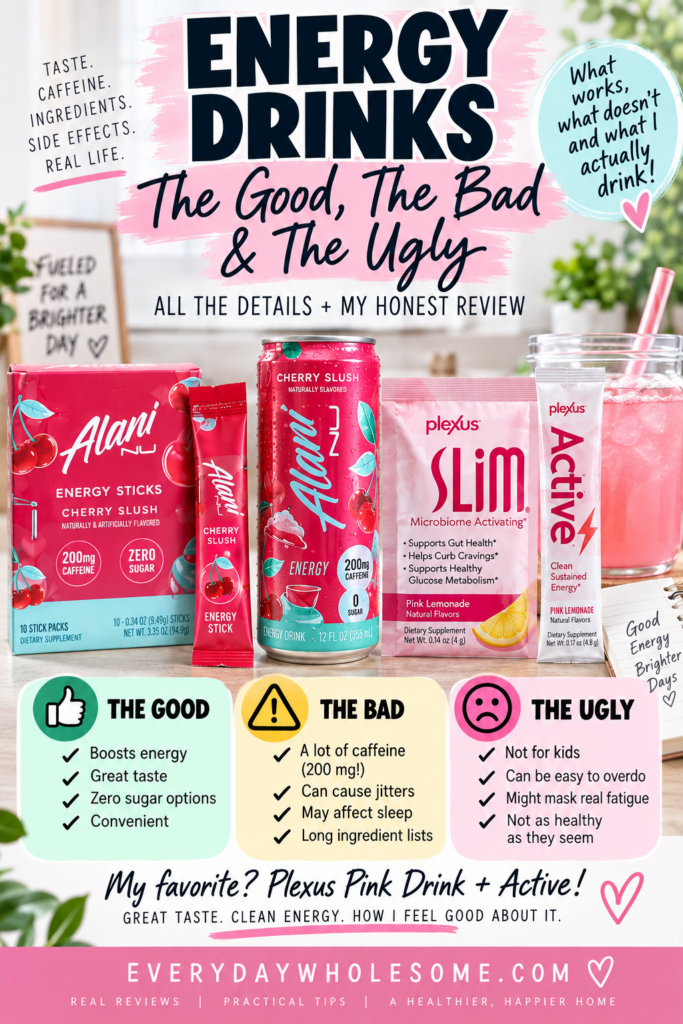
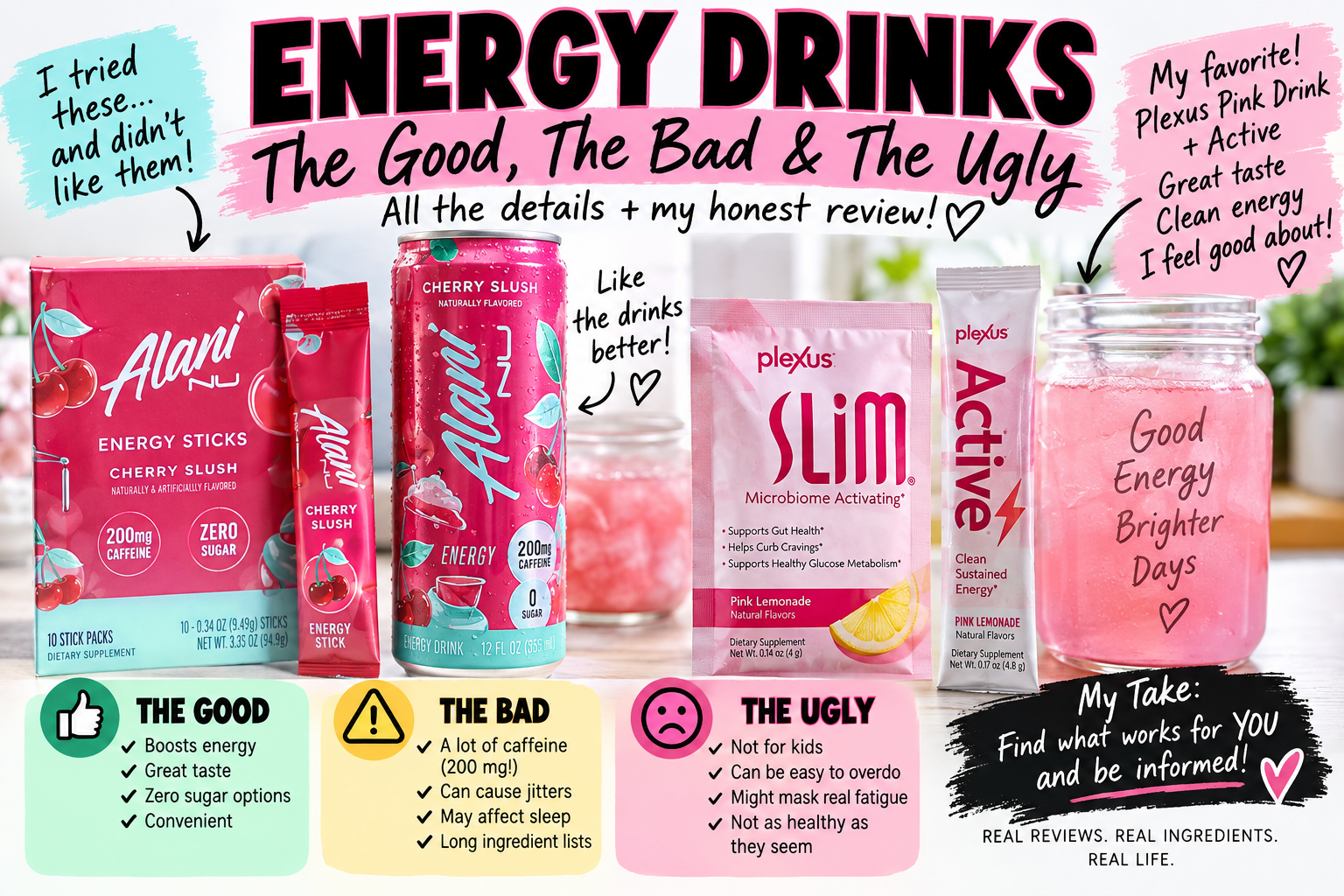
For example, Alani Nu Cherry Slush Energy has 0 grams of sugar and 200 mg of caffeine per can. The Cherry Slush Energy Stick also has 0 grams of sugar and 200 mg of caffeine.
If the choice is between a giant sugary soda and a zero-sugar energy drink, I can understand why people are attracted to the energy drink.
But sugar-free doesn’t automatically mean “healthy.”
You still have to look at everything else.
3. Some Taste Really Good
This is honestly part of the problem.
Some energy drinks taste like candy.
I actually like the Alani Nu canned drinks much better than their energy powder sticks.
And that surprised me.
I Tried the Alani Nu Cherry Slush Energy Sticks…and Didn’t Like Them
I bought:
Alani Nu Energy Sticks — Cherry Slush
10 Count
200 mg Caffeine
Zero Sugar
Shop the Alani Nu Cherry Slush Energy Sticks at Walmart
I thought I would like having individual packets.
They are convenient.
Throw one in your purse, add it to water, and theoretically you have an instant energy drink.
But I just didn’t like them.
My biggest issue?
NO CARBONATION.
Apparently part of what I like about an energy drink is the fizzy, cold, carbonated drink experience.
Mixing the Cherry Slush packet into regular water just wasn’t the same for me.
And despite being a little packet, it is not a small dose of caffeine.
One packet contains 200 mg of caffeine. It also contains ingredients including taurine, caffeine, sucralose, L-theanine, L-carnitine, acesulfame potassium, ginseng and guarana.
So don’t mistake a tiny packet for a tiny serving of caffeine.
I Actually Like the Alani Cans Better
The canned Alani Cherry Slush also contains 200 mg caffeine, but I prefer drinking it.
It is carbonated.
It tastes better to me.
It feels more like an actual treat when I want an energy drink.
The current Cherry Slush formula is sugar-free and includes caffeine, taurine, L-theanine, sucralose, acesulfame potassium, ginseng, guarana and B vitamins, among other ingredients.
Would I personally drink several in one day?
Absolutely not.
One 200 mg can is already a substantial amount of caffeine.
THE BAD: 200 mg of Caffeine Is a LOT
This is probably my biggest complaint about the modern energy drink world.
Why does everything need 200 milligrams of caffeine?
Sometimes I just need a little boost.
I don’t necessarily want the equivalent of a very caffeinated coffee hitting me all at once.
If the FDA’s commonly cited amount for most healthy adults is around 400 mg daily, one 200 mg energy drink uses up half of that before you count anything else you drank that day.
And caffeine sensitivity is incredibly individual.
Too much can make some people feel:
- jittery
- anxious
- shaky
- nauseated
- wired but tired
- unable to sleep
- like their heart is racing
- irritable
- or completely exhausted once it wears off
If you need three energy drinks just to function, I would start looking at why you are so tired, rather than simply continuing to add more caffeine.
Sleep matters.
Food matters.
Hydration matters.
Iron, thyroid, hormones, medications, stress, sleep apnea and many other things can affect energy.
Caffeine can temporarily cover fatigue without fixing its cause.
THE UGLY: Energy Drinks and Kids
This one is important to me as a mom.
Energy drinks are not kids’ drinks.
They’re not sports drinks either.
The American Academy of Pediatrics has warned that stimulant-containing energy drinks are not appropriate for children and adolescents.
Even Alani’s own product information states that its 200 mg caffeine drinks are not recommended for children, people sensitive to caffeine, pregnant women, or women who are nursing.
That is worth remembering because these cans often look fun, colorful and candy-like.
A teenager seeing “Cherry Slush” may not mentally translate that into:
200 milligrams of stimulant.
I wouldn’t treat an energy drink the way I treat a flavored sparkling water.
They are completely different products.
What About All the Extra Ingredients?
This is where energy drinks get complicated.
You will commonly see things like:
- taurine
- L-theanine
- guarana
- ginseng
- B vitamins
- L-carnitine
- green tea extract
- green coffee bean extract
- amino acids
- artificial or alternative sweeteners
Some ingredients have research behind specific uses.
Others are included in blends where it is difficult for the average consumer to know whether the amount in the drink is even enough to accomplish what the marketing suggests.
And more ingredients do not automatically make a beverage healthier.
Sometimes I would rather see a simpler ingredient list and less caffeine than an enormous “energy blend.”
My Favorite: Plexus Pink Drink + Active
Of everything I’ve tried, my personal favorite is still the Plexus Pink Drink along with Plexus Active.
This is the combination I personally feel best about using.
And importantly, these are actually two different products.
Plexus Slim — AKA “The Pink Drink”
Plexus Slim Microbiome Activating is not really an energy drink in the same category as a 200 mg canned energy drink.
One packet contains XOS prebiotic plus a blend that includes green coffee bean extract, garcinia cambogia, alpha lipoic acid and white mulberry extract. The green coffee bean extract contains less than 2% naturally occurring caffeine.
I like the Pink Drink because I genuinely enjoy drinking it.
For me, taste matters.
If I’m trying to replace a soda or a traditional energy drink, I need something I actually want to drink.
Then I Add Plexus Active When I Want Energy
Plexus Active is the actual energy component.
Plexus states that Active provides 100 mg of caffeine from green tea and yerba maté.
That is one of the main reasons I prefer it.
I don’t always feel like I need 200 mg.
Active gives me a noticeable boost without automatically starting at that higher dose.
It also contains ingredients including L-theanine, citrulline malate, N-acetyl-L-tyrosine, green tea, yerba maté and plant extracts, along with vitamins.
And I love the taste.
Why I Personally Prefer Plexus
For me, it comes down to:
Taste + amount of caffeine + ingredients + how I feel afterward.
I personally like having the Pink Drink and adding Active when I actually want extra energy.
I like that Active has 100 mg caffeine rather than the 200 mg found in one Alani Energy Stick or Cherry Slush can.
That gives me more control.
And I like the overall experience better.
I would describe it as a cleaner-feeling energy option for me personally.
However, I want to be careful with the word “safe.”
I cannot say that Plexus has been proven to be “the safest energy drink.”
Supplements and caffeine-containing products can affect different people differently, and “natural caffeine” is still caffeine.
But based on the products I have personally tried, Plexus Pink Drink + Active is the option I personally prefer and feel most comfortable using.
That’s different from claiming it is medically proven to be safer for everyone.
Natural Caffeine Is Still Caffeine
This is another marketing trick worth understanding.
“Caffeine from green tea.”
“Natural caffeine.”
“Yerba maté energy.”
“Green coffee energy.”
Those descriptions sound gentler.
But your body still receives caffeine.
The source may matter for the overall ingredient profile, but you still need to count those milligrams toward your total caffeine intake.
I think the dose deserves at least as much attention as where the caffeine came from.
And Don’t Forget About Sleep
Here’s the most annoying truth about energy drinks:
Sometimes the thing making us need an energy drink is…the energy drink.
Drink caffeine too late.
Sleep poorly.
Wake up tired.
Drink more caffeine.
Stay awake later.
Repeat.
That cycle can sneak up on you.
If you’re struggling with sleep, pay attention to what time you are consuming caffeine—not just how much.
Energy Drinks: My Good, Bad & Ugly Summary
THE GOOD
Energy drinks can:
- improve alertness
- help during an occasional afternoon slump
- taste great
- offer lower-sugar or zero-sugar alternatives to soda
- be convenient
THE BAD
They can also:
- contain a surprisingly large amount of caffeine
- make it easy to unknowingly consume too much caffeine
- cause jitters or interfere with sleep
- contain long lists of stimulants and supplemental ingredients
- make you feel like you have energy when your body actually needs rest
THE UGLY
My biggest concerns are:
- treating energy drinks like ordinary beverages
- kids and teenagers drinking them
- consuming multiple high-caffeine products in one day
- assuming “sugar-free” means healthy
- assuming “natural caffeine” means unlimited caffeine
- using caffeine every day to cover chronic exhaustion
What I Would Buy Again
Alani Nu Energy Sticks?
No.
They are convenient, but I didn’t enjoy drinking them.
The Cherry Slush stick has 200 mg of caffeine, and without carbonation, it just wasn’t worth it for me.
Alani Nu canned drinks?
Yes, occasionally.
I like them much better than the sticks.
They’re cold, fizzy and taste like an actual energy drink.
But because they contain 200 mg caffeine, I personally think of them as an occasional high-caffeine drink—not something to mindlessly sip all day.
Plexus Pink Drink + Active?
My favorite.
I like the taste.
I like being able to drink the Pink Drink and decide whether I actually want to add an energy product.
And when I do use Active, I like that it provides 100 mg of caffeine rather than immediately giving me 200 mg.
For me, that combination wins.
My Bottom Line on Energy Drinks
I don’t think we need to be terrified of caffeine.
I also don’t think we should pretend energy drinks are basically flavored water.
They aren’t.
Read the label.
Look at the caffeine amount.
Pay attention to how your body responds.
Don’t forget the coffee you already drank that morning.
Don’t give high-caffeine energy drinks to kids.
And if you are exhausted every single day, look beyond the next can of caffeine and figure out what your body is actually asking for.
For me?
I’ll skip the Alani Nu powder sticks.
I’ll occasionally enjoy a fizzy canned energy drink.
But my favorite everyday option remains my Plexus Pink Drink, with an Active stick when I actually need the extra energy.
Because I don’t necessarily need 200 mg of caffeine.
Sometimes I just need a little help getting through the afternoon.